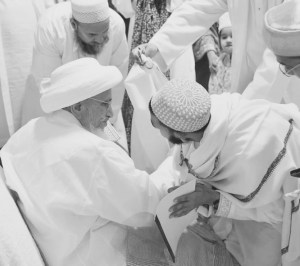
Ikseer Laa Ke Rakho To Chu’ae Na Haath Se, Jiss Ne Uthai Khaak Tere Aastaan Ki

جز آستان توام در جهان پناهی نیست
سرِ مرا به جز این در حواله گاهی نیست

Except for Your threshold, I have no refuge in this world;
For my head, there is no place of surrender but this door.

— Hafiz Shirazi

Touch is the first sense through which we meet the world, and the last to leave us as we stand close to death. It is often said that touch comes before sight, before speech. It is our first language and our final one, and it never lies. Our bodies seem to agree. Even before birth, a child is wrapped in fine hairs, lanugo, as if the body is preparing itself to feel before it learns to see or speak.

That is why touch holds the ability to heal. A held hand can calm pain in a way words never can. At the moment of death, it may feel as if the comfort of touch is taken away, but those who have felt the touch of the soul know something else. They know they are not alone.

On the 13th of October 2023, my daughter Nafeesa met with an accident at school and broke her arm. She was in severe pain when we rushed her to the hospital. The fracture was serious. She needed immediate elbow surgery, and a steel wire was inserted.

The surgery took place the next day, on the 14th of October. We were told that the wire and plaster would be removed after a month. Each day, we reassured Nafeesa that she was getting better, that soon she would be able to use her hand normally again.

We held on to that hope.

Finally, on the 14th of November, the plaster and wires were removed. Her arm looked fine. She could move her elbow without pain. We felt relieved. But moments later, Nafeesa said something that froze us. She said she could not feel her thumb. It felt as if it did not exist. Our relief vanished. We rushed back to the hospital. The doctors were confused and visibly shaken. We were told to wait for a few days. Perhaps, they said, it was just the effect of having the plaster on for so long.

We could see from their faces that something was not right. We overheard them quietly suggesting that the wire insertion might have caused this.

We returned home. Nafeesa tried to hold a pencil. She could not. We were devastated. There was nothing to do except wait and hope.

It was during this difficult time that we learned that Mufaddal Moula TUS would be visiting Karachi. The news felt like a gentle touch on the soul.

On the 20th of November 2023, we went to Aqa Moula’s bethak with Nafeesa and an araz in our hands, seeking shifa. Moula read the araz. I said softly, “Moula, haath na angutha ma jaan nathi.” Moula paused. He looked at Nafeesa and asked, “Aim kem jaan na hoi?” He then asked the doctors present to understand the situation fully. After listening, Moula mentioned a specific doctor and instructed us to consult him.

On the 25th of November, we went to see the doctor Moula had directed us to. Despite having a waiting list of over two months, he saw us immediately upon learning that Moula had sent us. He examined Nafeesa’s thumb carefully and his concern was evident. He told us that this condition was most likely a result of the surgery and that it was uncommon. He tried different methods, but Nafeesa felt nothing. He advised us to continue with a splint bandage for a few months. If there was still no improvement, he said, another surgery might be the only option, and even then, the chances of the thumb functioning normally were grim.

His words left us with very little hope.

The next day was Sunday. Moula was blessing the shops of the mumineen with qadam mubarak. He was present at a shop across from my house. I stood there for didar, holding Nafeesa in my arms, tears in my eyes. I had removed the splint from her hand. In my heart, I kept repeating: “Moula, aap shifa aapso.”

Moula came out of the shop and walked toward where we were standing. I could not speak. Not a word. I only said “Moula” and brought my daughter forward. Moula looked at her, smiled, and gently held Nafeesa’s very hand with his haath mubarak. He held it for a few seconds, smiled again, and moved on.

I returned home overwhelmed with gratitude, calm, and a quiet sense of certainty.

As we were still talking about what had just happened, something caught my eye. Nafeesa was lifting and holding things normally, easily, naturally. We stood still. None of us could believe it.

It was not the same hand. It was a hand that had been touched and held by the one who keeps reminding us that we are never alone.

Not here. And not in the hereafter.


Behn Batool Juzer Bhai Abadaniwala

Karachi, Pakistan


In the means of shukr and zikr, anyone who is willing to share his/her’s acquaintance, incident or any experience with Moulana Muqaddas RA or Moulana Mufaddal Saifuddin TUS can mail it to dm@tazkerat.org & md@tazkerat.org

Pabos Jo Huwa Shah-e ‘Aali Janab Ka, Paaya Khitaab Usne Sa’adat Ma’aab Ka

در پردۀ اسرار کسی را ره نیست
زین تعبیهٔ جان هیچ‌کس آگه نیست
جز در دل خاک هیچ منزل‌گه نیست
مِی خور که چنین فسانه‌ها کوته نیست

Behind the veil of secrets, no one can grasp all truths.
No soul can be fully aware of its fate or destined route on its own.
The only refuge for humanity lies in acknowledging its ultimate return to the earth’s embrace.
So drink the wine of knowledge, for the tale of destiny is not short, there is still a long way to go.


The fundamental principle in epistemology is to always remember that we do not know everything.

It was September 2019 when I began living my lifelong dream. I had enrolled in a Bachelor’s program in Computer Science and Engineering at the Budapest University of Technology and Economics in Hungary. With the prospects of a successful career in sight, I was happily settling into my new life.

Then came COVID-19. The university shifted to online classes, and in March 2020, I decided to travel back home to Ajman to stay with my parents until on-campus sessions resumed. For a year, I continued my classes online. By the end of 2021, I was preparing to return to Budapest.

Around this time, in December 2021, Mufaddal Moula TUS visited Sharjah, and we had the Sharaf of hosting a zyafat at our home. During the zyafat, when I approached Moula, he inquired, “Tame su karo cho?”

I replied, “Moula mein Budapest ma parhu chu, hamna online classes yahan si lau chu, hawe dubara Budapest jais.”

Moula looked at me and, with concern, said, “Hawe yahan par aj raho, bawaji sathey. Tame wahan chala jaso toh bawaji sathey kon rehse?”

He then turned to my father and said, “Tamara dikra ne aik business ni line bhi aapjo.”

For a brief moment, my dream of studying in Budapest flashed before me. But then I realized that Moula was in front of me, and I revisited the fundamental principle of knowledge: I do not know everything. If anyone cares for me more than I care for myself, it is him.

I had already paid the term fees in Budapest. Transferring to a university in the UAE would mean starting the year anew, and the competitive job market here made my career prospects uncertain. Yet, with complete confidence and trust, I responded, “Jee, Moula.”

Shortly after I resumed my studies in the UAE, the Ukraine-Russia conflict erupted. Hungary, a close ally of Russia, faced severe economic disruptions, fee hikes, safety concerns for foreign students, and travel restrictions. The social environment deteriorated.

Had I remained in Budapest, I would have been alone, surrounded by uncertainty, while my parents back home would have been stressed and left to face everything on their own.

Today, I am nearing the completion of my Bachelor’s program and actively managing my own business, which we started right after the zyafat, as per Moula’s directives.

The Ponzo Illusion teaches us that due to our limited capacity to perceive all angles simultaneously, we may believe two identical lines are of different lengths because of perspective. Yet, they are the same.

My experience has taught me that instead of trying to determine the length of lines in any situation, we should draw the line of Moula’s directives beneath them. That line truly becomes our lifeline, shielding us from the fault lines of life.


Mohammed Bhai Mustansir Bhai Bhinderwala

Ajman, UAE


In the means of shukr and zikr, anyone who is willing to share his/her’s acquaintance, incident or any experience with Moulana Muqaddas RA or Moulana Mufaddal Saifuddin TUS can mail it to dm@tazkerat.org & md@tazkerat.org

Tab Tak Salamat Aap Rahein Khalq Mein Huzur, Jab Tak Baqa Jahan Mein Ardo Sama Ki Hai

As a nutritionist specializing in the care of diabetic and cancer patients, I have always been a steadfast advocate for the remarkable qualities of honey. Beyond its numerous health benefits, honey is nature’s ultimate preservative. Anything surrounded by its embrace is protected and safeguarded.

My story has a symbolic association with the above.

On the 7th of April 2024, 29th of Shahre Ramadan, I was waiting for Moula’s TUS didar after fajr namaz at Saify Mahal. I had been working on developing a game aimed at creating protocols and tools for paediatric cancer patients to test their efficacy levels. That morning, I was there to present the draft of my work to Moula TUS.

When Moula arrived, he asked, “Tame su karo cho?”

I replied, “Moula, mein nutritionist chu, diabetic aney cancer patients ne insulin guidance aapu chu.” As Moula TUS nodded, I presented the draft of the game on my laptop. Moula listened to my araz with keen attention. Then, to my utter astonishment, Moula said, “Tame aaney copyright karawi lejo.” I froze, caught off guard by his foresight and care. With a smile, Moula TUS repeated, “Copyright karawi lejo. Tamam logo ne, ibadullah ne bhi faido thai”.

I performed salam and Moula departed. I had touched honey.

Months passed. On the 21st of November, 20th of Jamad al-Ula, Moula graced our house in Itarsi with his presence. As my family members performed salam and presented their araz, my turn came. I had with me the final draft of the game, ready to present it to Moula TUS. Yet, before I could speak a word, Moula looked at me and asked, “Tame copyright karawi chuka cho ne?”

I replied, “Jee, Moula.”

With a radiant smile, Moula placed his Haath Mubarak on the game.

Even now, as I recall that moment, I can feel the sweetness of his beaming smile and the warmth of his protective Nazar Mubarak.

Having spent my life advocating for the protective qualities of honey, I experienced it in its truest and most profound sense that day. Moula’s TUS care was not just about ensuring the copyrights of the game, which I later realized was extremely crucial as I progressed in my PhD; It was his way of extending his assurance, his promise that he would always safeguard us, surrounding us in his love and protection just as honey preserves and protects whatever it embraces.


Behn Tasneem Abbas Bhai Kapasi

Jalgaon, India


In the means of shukr and zikr, anyone who is willing to share his/her’s acquaintance, incident, or any experience with Moulana Muqaddas RA or Moulana Mufaddal Saifuddin TUS can mail it to dm@tazkerat.org & md@tazkerat.org

Millat Ke Wo Rehbar Ko Hum Kabhi Na Bhulenge, Shah Saife Deen Sarwar Ko Hum Kabhi Na Bhulenge

Guardian angel: that’s how I remember Moulana Taher Saifuddin RA. From the most trivial issues to life-threatening hardships, he was always there as a saviour.

I was about 10 years old, a mischievous kid often deserving the beatings I got.

On one instance, it was Moulana Taher Saifuddin’s Milaad Mubarak and Moulana RA was in Mumbai. I would eagerly await his presence during such festivities because he would treat the children with mewo – a handful of sweets and chocolates.

On that special day, Moulana Taher Saifuddin RA was at Saifee Masjid. My grandmother reminded me to go and extend the felicitations. I rushed to Saifee Masjid to do salaam and collect my goodies. As I stood in front of Moulana RA, something strange transpired. Without thinking, I lifted my shirt and said, “Moula jo mane mara maa maare che.” I still don’t know why I did that.

Moulana Taher Saifuddin RA smiled and calmly told me to inform my mother that he wanted to see her. About ten minutes later, I stood before him with my mother. 

I vividly remember Moulana Taher Saifuddin RA looking at us keenly. He asked my mother, “Tamne khabar che aa kon che?” She stayed quiet. After a brief pause, he added, “Aa sagla mara bachao che, mara che, maro nahi ehne.”

His voice was firm, his gestures steady, and his eyes resolute.

My mother nodded, and I left with an intense feeling of protection and warmth.

Today, whenever I see a hardship befalling or a calamity trying to strike me, I transport myself to his Qabr Mubarak and hear his words: “Mara che, maro nahi ehne.”


Shk Saifuddin Bhai Husseinibhai Bhol

Mumbai, India


In the means of shukr and zikr, anyone who is willing to share his/her’s acquaintance, incident, or any experience with Moulana Muqaddas RA or Moulana Mufaddal Saifuddin TUS can mail it to dm@tazkerat.org & md@tazkerat.org

Behr-e Sakha o Faiz Tera Wo Hai Mojzan, Darya-e Be’kanaar Bhi Aya Shumaar Mein

In 1997, during Moulana Mohammed Burhanuddin’s RA visit to Bangkok, I was fortunate to be there. I would be around Moula RA through the day and night; from talaqqi to salaam, from takbeera to azaan, I got all that I had never even dreamt of.

Yet, there was something I had been praying for for many years. My hopes were low, but I knew if there was anyone who could change my situation, it was Moulana Mohammad Burhanuddin RA.

On one instance, during a qadambosi bethak, I performed salaam and with tears in my eyes, I uttered: ‘Moula mari shaadi ne ghana waras thai gaya, mara paase farzand nathi’.

Moula RA looked at me for some moments, and stated: ‘mari aankho ma dekhi ne kaho ke mein Karbala ni zyarat karwa jais’. Tears welled up in my eyes, and I looked up and responded: ‘Moula mein Karbala jais’.

Just as I was moving away, Moula RA stopped me, blessed me with a radiant smile, and proclaimed in an assertive and joyous voice: ‘pachi dikro thai to mara paase lawjo’.

Words cannot describe how I felt in that moment. The world around me stopped, and I could feel a child in my arms. My heart was brimming with gratitude and hope.

I went to Karbala shortly afterward. Burhanuddin Moula RA visited Karachi the next year, and I went to Burhani Mahal with my son. As Moula RA passed by us, with tears in my eyes and a child in my hands, I said: ‘Moula aa farzand aapye aapu che, aapye farmayu hatu mara pase lai ne awjo’.

Moula RA stopped, graced us with a warm, reassuring smile, blessed my son with his Nazar Mubarak, and walked forward to numerous other mumineen who were most certainly standing there just like me, blessed by Moulana Mohammad Burhanuddin’s RA touch of life.

I am just among the thousands.


Alamdar Hussain Bhai Darugar

Karachi, Pakistan


In the means of shukr and zikr, anyone who is willing to share his/her’s acquaintance, incident, or any experience with Moulana Muqaddas RA or Moulana Mufaddal Saifuddin TUS can mail it to dm@tazkerat.org & md@tazkerat.org

Wo Sar Buland Huwa Hai Jahan Mein Ahmed, Huzur-e Sarwar-e-Deen Jisne Sar Jhukaya Hai

The year 1412 AH held immense significance in my life. After facing numerous challenges, I managed to secure a US visa to pursue computer graphics courses. In the same year, during my time in Dubai, I was blessed with the khidmat sharaf of transcribing the collection of Syedna Taher Saifuddin’s RA Qasaid Sharifa.

Life seemed to be going perfectly, and I was engulfed by happiness and satisfaction.

Ashara Mubarakah in 1413 AH was held in Pune. After completing half of the project in Dubai, I returned to India for the occasion. Unfortunately, my Dubai visa had expired, and I was in the process of renewing it while continuing my work at Badri Mahal in Mumbai.

One fateful Wednesday at Victoria Terminus station, as I bid farewell to my sister, a pickpocket snatched my passport from my kurta pocket. Panic and sorrow overwhelmed me as I realized the loss of not just my identity but also my dreams.

With a heavy heart and tearful eyes, I went back to the station and searched the entire place relentlessly, hoping against hope to find the passport. I continued doing rounds of the station and asking people through the next day.

On Friday, in the depths of despair, I went to Raudat Tahera, put my head on the Qabr Mubarak, and pleaded with tears rolling down: “Ae Moula, mane koi bhi tarah si aaj naj din ma mari passport mili jai, aap mari muraad koi bhi tarah poori kari aapye”.

With my heart laid bare, I was walking around the Qabr Mubarak when an acquaintance approached me and inquired about my distressed state. I informed him what had transpired to which he replied: “Taher Saifuddin Moula si maango, aap no waseelo lo, ye kai bhi kari sake che”.

After zyarat, I went to Badri Mahal to continue the work. Shortly afterward, I returned home for lunch as I was unable to lift myself up to continue the work with the same energy.

Then, at around 2:30 PM, an unexpected call came from my office colleague. A person had come with my passport and insisted on handing it over to me personally. Overwhelmed with shock and gratitude, I rushed to the office, but the person had already left, leaving an address behind.

Following the address, my colleague and I met a Madrasi hawker with a stall near VT station. He handed me my passport with a calm smile, seemingly curious about my reaction. As I stood there, puzzled, he began recounting the sequence of events leading to the recovery of my passport.

He had found the passport two days ago, after witnessing a man across his stall trying to hide and flipping through its contents. The man eventually discarded it near his stall, and the Madrasi Bhai picked it up, safeguarding it until the next day. That morning, he noticed the picture of me wearing a topi in the passport and asked his neighboring Mumin Bhai, who wore a similar topi, if he recognized the owner. The Mumin Bhai replied negatively but told the Madrassi Bhai that he would certainly ask around.

All of this was happening while I was at Raudat Tahera.

According to the norm, the Mumin Bhai went to the Badri Mahal masjid for Jumua namaz. He sat right next to the person I had met a short while ago in Raudat Tahera. Amidst a usual conversation, the Mumin Bhai mentioned the passport with his Madrasi neighbor having the name ‘Saifuddin’. The person who knew me curiously inquired if the name was ‘Shabbir’ and not ‘Saifuddin’. The Mumin Bhai said that he was not sure. After the namaz, they both went to the Madrasi Bhai which led to the serendipitous return of my lost passport.

For some, it may appear as a series of fortunate coincidences, but for me, it was a divine intervention, a testament to the power of Moulana Taher Saifuddin’s blessings. As my friend had said, “Moulana Taher Saifuddin kai bhi kari sake che”.

Moulana Mohammed Burhanuddin RA once stated “mumineen tamara sagla paase walayat nu passport che”.

And indeed, it does wonders.


Sheikh Shabbir Bhai Saifee

Houston, USA


In the means of shukr and zikr, anyone who is willing to share his/her’s acquaintance, incident, or any experience with Moulana Muqaddas RA or Moulana Mufaddal Saifuddin TUS can mail it to dm@tazkerat.org & md@tazkerat.org

Jaan Be’lab Hai Ye Tera Wasl Talab Ae Aqa, Ba’khuda Ab To Ise Shehd-Dahani Aawe

دی گفت طبیب از سر حسرت چو مرا دید
هیهات که رنجِ تو از سرِ قانون شفا رفت
Upon observing my distressing condition the doctors uttered in despair;
Your state (in love) is beyond any possibilities of cure.
– Hafez Shirazi

At the age of eight, I endured excruciating, relentless pain in my abdomen. Those years are etched in my memory as a cacophony of screams, tears, and convulsions while I writhed on the bed, tormented by the pain inside me.

My parents, witnessing my anguish, consulted several doctors in Karachi. One of them proposed the possibility of a twisted knot in my intestines, obstructing the natural flow of digestion and inflicting unbearable pain; however, nothing like that showed up in the reports. As the pain mercilessly intensified, a doctor prescribed a restrictive diet, allowing me to consume nothing but clear soup and toast, in the hope that it might provide temporary relief until a definitive diagnosis was made. For about six months, I dutifully consumed nothing else; yet, the pain kept worsening.

The specialists in Karachi, their brows furrowed with grave concern, grappled with the confounding enigma that was my condition. They probed and prodded, inserting enema tubes, and conducting X-rays repeatedly, but their efforts proved futile. Amidst the searing pain, I screamed and wailed. Finally, in a desperate final gambit, a specialist prescribed potent penicillin antibiotics. For thirty days, I endured the piercing sting of the penicillin injections. My body withered away, my strength evaporated, and I was reduced to a hollow shell of my former self. The school became a distant memory as it was eclipsed by the consuming pain that relentlessly gnawed at me.

Desperate to find an answer, my parents took me to Europe when I reached the age of nine. The doctors suspected tuberculosis and I underwent multiple tests in London, Germany, and Switzerland. Yet, to everyone’s astonishment, the results came back clear, providing no tangible medical solution to my distressing state.

Dejected and filled with dimming hopes, we returned home, the pain clinging to me like an indomitable specter. From enemas to penicillin, from one hospital to another, we endured an interminable cycle of agony and despair for another year. My parents spared no effort in their quest to alleviate my pain, yet their hearts broke when a family doctor informed them that the medicines I was consuming would start affecting my other sensory abilities.

The tender faces of my parents, once adorned with smiles, now wore a shroud of gloom and desolation. I was on the cusp of turning ten, and any semblance of improvement in my condition seemed an elusive dream. Doctors had resignedly counseled my parents to prepare for the worst, urging them to brace themselves for surgery, a desperate measure in the face of uncertainty.

Then, a ray of hope pierced the darkness that engulfed our lives. Syedna Taher Saifuddin RA graced Karachi with his presence that year, and we were blessed to host a zyafat at my kaka, Fakhruddin Bhai Valika’s home. Clutching onto the remnants of hope and with tears streaming down her face, my mother placed me before the revered presence of Syedna Taher Saifuddin RA, crying out, “moula mari dikri ne 2 waras si pait ma ghanu dard che, doctors ne khabar nathi parti ke su thai che, aim kahe che ke operation kari ne pait kholi ne dekhse, Moula mari dikri nu pait kai kabaat (cupboard) to nathi, ke kholi ne dekhse, hawe mein aap na paase awi chu, aap mane farmawo mein su karu, mein ghani mushkil ma chu”.

Attentively, Taher Saifuddin Moula RA listened to my mother’s anguished plea, his face adorned with a serene smile. And then, with calm authority, he spoke, “aik kilo mudh (honey) aney aik kilo kalonji lai ne ridge house par awjo”.

The following day, carrying one-liter honey and one-kilo black cumin we made our way to the ridge house. There, Syedna Taher Saifuddin RA blessed me with his nazar mubarak, his eyes filled with compassion, pronounced shifa, and stated: “roz ehne fajare, nahaar-mu, saat dana kalonji aney shehed na apjo, 2 waras tak aapjo, aney bani sake to zindagi bhar aapjo”.

Overwhelmed, my mother responded, her voice trembling: “Moula shifa nu shehed to khatam thai jase”. With a beaming smile, Taher Saifuddin Moula RA replied: “shifa ni kalonji che ne, ye rehse”.

Today, at the age of seventy-six, I stand as a testament to that lofty, miraculous, and fatherly presence of Syedna Taher Saifuddin RA; I have never felt any chronic pain in my abdomen from that fateful day to date. Although we never found out about the problem, my parents knew where to seek the answer.


Mulla Ruqaiyyah Bai Millwala

Houston, USA


In the means of shukr and zikr, anyone who is willing to share his/her’s acquaintance, incident, or any experience with Moulana Muqaddas RA or Moulana Mufaddal Saifuddin TUS can mail it to dm@tazkerat.org & md@tazkerat.org

Taweez Sheh Ke Haath Ki Hai Nuskha’e Shifa, Go Bu Ali Ke ‘Ehd Mein Apne Matab Nahin

آنچه من در عشق جانان يافتم

کمترين چيزها جان يافتم

Among all that I have gained in the love of the beloved;

The least significant is ‘life’.

In July 2017, my mother’s health suddenly started to deteriorate. After figuring out that the routine medication is not helping, I took her for an executive full-body check-up at Agha Khan Hospital.

The reports came out indicating something unusual with the blood and my fear intensified. The doctors suggested an immediate bone marrow examination. The results showed lymphoma: cancer.

I was left numb and devastated, unable to process the news. My world was crumbling apart.

Witnessing my mother’s deteriorating health, unable to eat, move, or respond, was excruciating. The thought of her undergoing chemotherapy was unbearable, and I was not ready to see her suffer.

As the chemo sessions started, my mother’s condition kept worsening by the day. Due to her weak state, the sessions that were supposed to take place one after another uninterruptedly had to be done in the intervals of eleven days.

The doctors had already informed me of the worst.

The next month, Mufaddal Moula TUS arrived in Karachi for Ashara Mubarakah 1439 H. The very next day, I took my mother to the qadambosi bethak at Burhani Mahal.

With tears rolling down my eyes and slowly moving the wheelchair with my mother, I reached Moula TUS and uttered: “moula mara maa ne cancer che, aap shifa aapi do”.

Upon hearing, Moula TUS looked into my eyes and gestured to lift my mother up from the wheelchair.

Moula TUS pronounced “khuda shifa aape”, extended his haath mubarak and brushed it on my mother’s face, and blessed us with a beaming smile.

From that day onwards, my mother has never needed a chemotherapy session or any treatment for that matter.


Mulla Saifuddin Bhai Joriawala

Karachi, Pakistan


In the means of shukr and zikr, anyone who is willing to share his/her’s acquaintance, incident or any experience with Moulana Muqaddas RA or Moulana Mufaddal Saifuddin TUS can mail it to dm@tazkerat.org & md@tazkerat.org

Hai Ye Tareeq Ishq Mohabbat Ki Raah Mein, Apne Saron Ko Paaon Banate Huwe Chalo

The word ‘miracle’ stems from the Proto-Indo-European word ‘meyh’ meaning ‘to smile’ and ‘to be astonished’; exactly telling of my state after what happened to me during Aqa Moula’s visit to Karachi this month.

Four days before Moula’s arrival in Karachi, I had a dream.

I was sitting among a huge crowd of mumineen who were sitting there for Moula’s didar. As Moula arrived, I began to weep with my hands folded. At that moment, among all mumineen, Moula looked at me and said: “su kaam che tamne, sukaam itnu roi raya cho?”.

With my arms trembling and tears running down the face, I replied in a shaky voice: “moula mein ghani bimar rahu chu, mein ghani pareshaan chu, moula aap jaano cho”.

Moula drew near and followed by a radiant smile gestured with his haath mubarak implying that he is there, he knows, and to stop worrying.

I woke up in tears; in gratitude, in the longing to be with Moula.

The next day, I found out that Moula is coming to Karachi. I told my daughter: “moula maraj waste padhari raya che”.

Moula arrived in Karachi on the 1st of Jamad al-Ukhra, 24th December 2022.

Every day, countless mumineen were fortunate to receive the sharaf of zyafat, qadam, majlis, and salam. Days passed and I was yet to do didar. However, regardless of my physical condition and humble circumstances, my heart knew: “moula maraj waste padhara che”.

All I prayed for was Moula’s didar; to be near him; to obtain a glimpse. Looking at myself, I did not know how all of that was possible; but I would look at his picture and tell myself: ÿe kai bhi kari sake che”.

On the seventh day of Moula’s visit, Friday, 7th Jamad al-Ukhra, just around maghrib an unknown number flashed on my mobile screen. As I answered, a bhai on the other end said: “behen hamna hamara ghare zyafat che, aney tamne izan che, tame awjo, shamil thajo”.

Shocked and astonished, I was unable to utter a word. The bhai further added: “zyafat waste ITS numbers apwa ma aik number mistakenly tamaro apai gayo che, Moula hamna padhare che, zarur awjo”.

Tears were pouring down and as I walked towards the house, I kept uttering to myself: “moula maraj waste padhara che”.

What happened next can not be precisely expressed through words. I was guided to the bethak room and after a while, Moula arrived. I kept crying.

Everyone was performing qadambosi. When it was my turn, Moula extended his haath mubarak and benevolently gestured for me to perform salam.

In those moments, I vividly felt that I was living the culmination of the dream I had: my face was drenched in tears, Moula had a broad smile and he looked at me, gestured with his haath mubarak and a soft nod telling me that he knows and listens.

I returned home smiling and astonished: indeed, I lived a miracle.


Behn Tasneem Aliasghar Bhai Godhrawala

Karachi, Pakistan


In the means of shukr and zikr, anyone who is willing to share his/her’s acquaintance, incident or any experience with Moulana Muqaddas RA or Moulana Mufaddal Saifuddin TUS can mail it to dm@tazkerat.org & md@tazkerat.org

‘Qalbi Ladaika’ Hai Ye Maqula Zabaan Ka, ‘Shouqi Ilaika’ Nikla Dil-e-Doorbeen Se

In one of his Ashara Mubaraka sermons in London, Syedna Mufaddal Saifuddin TUS mentioned the wonders of the world and while expounding on their rareness and the affection and liking they attract he referred to the mumineen and graciously stated: ‘haqeeqatan wonders of the world tame sagla cho’. The words reflect Moula’s high regard and eternal love for mumineen who are more rare and unique to him than the wonders of the world.

The words of Moula TUS brought to my mind a day in the year 1990 when Syedna Mohammed Burhanuddin’s RA visited Toronto, Canada for the second time.

Out of many sharafs, which included hosting Syedna Mufaddal Saifuddin TUS at our humble house, I was also blessed with the fortunate opportunity to perform khidmat and accompany Moulana Mohammad Burhanuddin RA to Niagara falls.

Even during the trip to Niagara falls, Burhanuddin Moula RA would attend to munineen and spend time listening to them. For the same purpose, Moulana Mohammed Burhanuddin RA’s three-day trip to Niagara was shortened to one day as a mumin bhai presented him with an araz to visit his house.

Moulana RA left the Marriot Hotel leaving behind the whole caravan which included all the Shehzada Sahebo and other members of Qasre Aali.

After Moulana RA had left, I was present at the hotel when Busaheba Amatullah Aisaheba QR and Syedna Mufaddal Saifuddin TUS were discussing what everyone should do as Moulana RA had left. Busahea QR, the light-hearted soul that she was, suggested to Mufaddal Moula TUS: ‘tame rokai jao’ to which Syedna Mufaddal Saifuddin TUS replied: ‘yahan rokai ne su karye, yahan to koi zyarat bhi nathi’ and expressed his wish to be with Moulana Mohammed Burhanuddin RA.

It was late in the night and I was driving Mufaddal Moula TUS and Amatullah Aisaheba QR back from Niagara; just three of us. Every once in a while, Mufaddal Moula TUS would inquire if I am feeling okay and comfortable driving. In one instance, Moula TUS woke up and asked: ‘bhai tame theek cho? Tamne neend to nathi awi rahi?. ‘Nai Moula’, I softly replied. Moula TUS added with a radiant smile: ‘Jo tamne neend awe to ghaari roki lejo aney yahan coke che, aankh ma charakjo to neend nai aawe’.

Astonished and amazed, I nodded with a smile.

Years later, we were driving to Dallas from Toronto, which is approximately a twenty-hour drive. My son and I had decided to take turns in driving through the route. My son was played out and it was my turn to take the wheel; however, I was equally tired as I had not rested enough when my son drove.

It was 2:30 am and just as I began to drive, I felt extremely sluggish and drowsy. My son had just slept and I had to find a way to drive through for at least a few hours before asking him to drive again. I took Syedna Mohammed Burhanuddin’s RA name and in that very moment, words of Syedna Mufaddal Saifuddin TUS came to my mind: ‘Jo tamne neend awe to ghaari roki lejo aney yahan coke che, aankh ma charakjo to neend nai aawe’.

I grabbed a coke, splashed some of it on my face, and started to recollect and relive all those blessed moments I had spent with Moula. We reached Dallas and I had been driving for more than ten hours without a sign of fatigue or weariness.

As I narrate this, I realize today that more than the coke, it was the recalling of all those beautiful memories of Moula that brought about a breath of fresh air and enkindled a sense of vigor within the spirit.

That is exactly what memories of Moula do to mumineen; refresh their hearts and souls.

The images are the exclusive property of the contributor and Tazkerat, and may not be copied, printed or otherwise disseminated without permission.


Sheikh Hakimuddin Bhai Shakir

Toronto, Canada


In the means of shukr and zikr, anyone who is willing to share his/her’s acquaintance, incident or any experience with Moulana Muqaddas RA or Moulana Mufaddal Saifuddin TUS can mail it to dm@tazkerat.org & md@tazkerat.org